
Current Status

Not Enrolled

Price

Included in Core Compliance Suite – from £49

Get Started

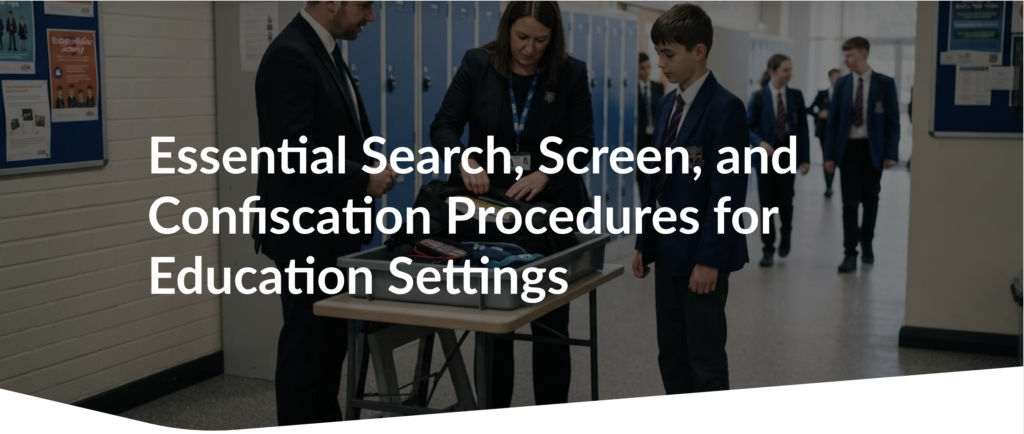
Search, Screening and Confiscation Training for Schools

Develop the Knowledge and Confidence to Manage Searches, Screening and Confiscation Safely

Searching, screening and confiscation can form an important part of maintaining a safe and orderly education environment. Schools must ensure that staff understand their responsibilities, the limits of their authority and the safeguards that should be followed when responding to situations involving prohibited, banned or potentially harmful items.

Our Search, Screening and Confiscation course has been developed specifically for schools, academies and trusts. It provides staff with the knowledge and practical understanding needed to respond appropriately to situations involving searching, screening and confiscation while protecting the safety, dignity and wellbeing of pupils and staff.

This online course explores the legal and statutory framework, when and how searches may take place, prohibited and confiscated items, appropriate safeguards, and the importance of recording and reporting actions in line with the school’s policy.

Course duration: 5–10 minutes
Assessment: Short knowledge check
Certificate: Available on successful completion
Designed for: Schools

This course provides practical guidance to help staff understand and apply appropriate procedures for searching, screening and confiscation in schools. You’ll learn:

  • The legal framework and statutory guidance.
  • When a pupil may be searched and who is authorised.
  • The difference between searches with and without consent.
  • Prohibited, banned and potentially harmful items.
  • Safeguards before, during and after a search.
  • Individual needs, including SEND and reasonable adjustments.
  • How confiscated items should be handled.
  • Recording, reporting and escalation.
  • How to apply the guidance to realistic school-based scenarios.

This course is suitable for school leaders, teachers, pastoral staff, safeguarding teams and other members of staff who may be involved in, support or need to understand procedures for searching pupils, screening and confiscating items.

It is particularly useful for staff who may need to make decisions about searches or respond to situations involving prohibited, banned or potentially harmful items.

Yes. Learners who successfully complete the course and meet the required assessment standard will receive a Search, Screening and Confiscation Training for Education Settings certificate.

The certificate provides a record of course completion and can be downloaded from My Learning. Course completion supports staff training and awareness but does not, by itself, demonstrate that an organisation has met all of its legal or statutory responsibilities.

Why choose The Compliance Classroom?

  • Developed exclusively for schools, academies and trusts.
  • Updated regularly to reflect current legislation and statutory guidance.
  • Created by experienced education professionals.
  • Clear guidance on staff responsibilities, authority and safeguards.
  • Flexible online learning available anytime, anywhere.
  • Knowledge checks and certificate upon successful completion.
  • Supports consistent practice and a safe school culture.

Search, Screening and Confiscation Training for Schools FAQs

Quick answers to common questions about searching, screening and confiscation in schools.

Headteachers and members of staff authorised by the headteacher have statutory powers to search a pupil or their possessions where there are reasonable grounds to suspect they have a prohibited item or an item identified in the school rules as searchable. Staff should understand the limits of these powers and follow the appropriate safeguards and school procedures.

Authorised staff may search for prohibited items including knives and weapons, alcohol, illegal drugs, stolen items, tobacco and cigarette papers, fireworks and pornographic images, as well as articles suspected of being used to commit an offence, cause injury or damage property. Schools can also identify additional searchable items within their rules.

Yes. School staff have powers to confiscate certain prohibited or banned items, items that pose a risk, and items that may constitute evidence of an offence. Items may also be confiscated as a disciplinary sanction where appropriate. What happens to an item afterwards will depend on what it is and the circumstances in which it was found.

Searching should be handled sensitively, proportionately and with regard to the pupil’s safety, dignity and wellbeing. The circumstances of the search determine the safeguards required, including considerations around the sex of the staff member carrying out the search, witnesses, privacy and the extent of clothing that can be removed. Staff should follow statutory guidance and their school’s agreed procedures.

Yes. The course explains the legal framework and Department for Education guidance surrounding searching, screening and confiscation and helps staff understand how these requirements apply in practice.

Course completion supports staff knowledge and awareness but does not, by itself, demonstrate that a school has fulfilled all of its legal or statutory responsibilities.

Yes. The course has been developed specifically for the education sector, using realistic school-based situations and practical examples. It is suitable for school leaders, teachers, pastoral and safeguarding teams, governing bodies and other staff who need to understand searching, screening and confiscation procedures.